Monetary Policy in Times of Crisis by unknow
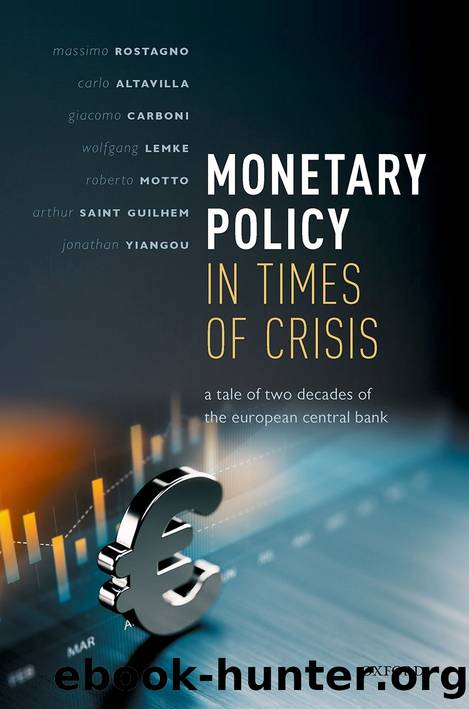
Author:unknow
Language: eng
Format: epub
ISBN: 9780192649287
Publisher: OUP Premium
Published: 2021-04-28T00:00:00+00:00
4.5.2 Stimulus Amplifiers
Between October 2008 and May 2009, the ECB cut its main refinancing rate by 325 bps. But, if measured by the concomitant drop of the EONIA, the easing of the stance was in fact more proactive, and closer to 400 bps. No doubt, the stimulus was massive and highly concentrated in time. Its propagation to the real economy faced two cross-currents, one amplifying the impact of the extraordinary monetary treatment that was being applied, and one restraining it.
The amplifier of transmission was certainly associated with the ECBâs bold pledge that it would exercise the central bankâs traditional role of last-resort provider of liquidity to sound financial institutions without restrictions. There were no restrictions on the amount of central bank credit that a solvent credit institution could secure in weekly operations against eligible collateral. And the ECB progressively extended the maturity at which such unlimited liquidity was made available to the counterparties. In doing so, the ECB enhanced the stability of the euro area financial system, defused the threat that financial institutions might respond to the funding crunch and lack of visibility about their ability in the future to borrow funds when necessary by curtailing credit to the broader economy and, indirectly, reduced the overall cost of capital to banks.
What would have happened if the demand for liquidity had not been satisfied unboundedly in the Eurosystem liquidity-providing operations? We simulate the extreme case, in which the Eurosystemâin keeping with the pre-crisis practice of variable rate tender proceduresâwould have allowed the preset allotments at its liquidity-providing operations to increase at the same pace as the estimated âliquidity needsâ narrowly defined. The latter aggregate quantifies the minimum volumes of liquidity borrowing that would have just enabled banks to fulfil their minimum reserve requirements and cover for changes in the publicâs demand for banknotes and for autonomous variations in the accounts held by some governments at their national central banks. As explained more extensively in Box 4.2, in pre-crisis times, such estimated âliquidity needsâ were the main reference statistic used to calibrate the preset volume of liquidity supply in the weekly refinancing operations.
Specifically, we run counterfactuals with the CMR model to assess the impact of the liquidity measures. To separate out the specific impact of FRFA from the concomitant expansion of the spectrum of maturities at which liquidity was provided in unlimited volumes we proceed in incremental steps: the first counterfactual singles out the impact of the maturity extension, and the second turns to quantify the impact of FRFA per se.
To assess the role played by the maturity extension we note that the announcement of the maturity extension has left an imprint in the model estimates in the form of an accommodative expected (signal) component of the monetary policy shock process, which also helps explain the smaller-than-usual increase in the spread between the ten-year long-term rate and the short-term rate. Typically, an expected policy shock has very little impact on the long-term interest rate in the euro area. We compute the impact
Download
This site does not store any files on its server. We only index and link to content provided by other sites. Please contact the content providers to delete copyright contents if any and email us, we'll remove relevant links or contents immediately.
| Anthropology | Archaeology |
| Philosophy | Politics & Government |
| Social Sciences | Sociology |
| Women's Studies |
The Secret History by Donna Tartt(19128)
The Social Justice Warrior Handbook by Lisa De Pasquale(12199)
Thirteen Reasons Why by Jay Asher(8927)
This Is How You Lose Her by Junot Diaz(6900)
Weapons of Math Destruction by Cathy O'Neil(6290)
Zero to One by Peter Thiel(5816)
Beartown by Fredrik Backman(5772)
The Myth of the Strong Leader by Archie Brown(5517)
The Fire Next Time by James Baldwin(5458)
How Democracies Die by Steven Levitsky & Daniel Ziblatt(5227)
Promise Me, Dad by Joe Biden(5161)
Stone's Rules by Roger Stone(5095)
A Higher Loyalty: Truth, Lies, and Leadership by James Comey(4974)
100 Deadly Skills by Clint Emerson(4936)
Rise and Kill First by Ronen Bergman(4804)
Secrecy World by Jake Bernstein(4762)
The David Icke Guide to the Global Conspiracy (and how to end it) by David Icke(4730)
The Farm by Tom Rob Smith(4518)
The Doomsday Machine by Daniel Ellsberg(4497)
